

Deadwood Removal: Why Removing Dead Branches Can Benefit Your Trees

A dead branch is not always a problem that needs to be removed. Deadwood is a natural part of a tree's life cycle and can provide valuable habitat for insects, fungi, birds and bats.
However, when dead branches are large, unstable or positioned above areas used by people, vehicles or buildings, they can present a safety risk. In these situations, carefully removing selected deadwood can help reduce the risk of branch failure while keeping the tree's natural structure intact.
Deadwood removal is therefore not simply about making a tree look tidier. It is about assessing the tree, understanding the surrounding environment and deciding which dead branches should be retained for their ecological value and which may need to be removed for safety.
What Does Deadwood Mean in a Tree?
Deadwood refers to branches, limbs or other parts of a tree that have died while other parts of the tree remain alive. It can range from small dead twigs within the canopy to substantial dead branches and limbs.
Deadwood can develop for a number of reasons, including:
Natural shading within a dense canopy
Storm damage or broken branches
Drought or other environmental stress
Root damage or soil compaction
Pests and diseases
Fungal activity and decay
Natural ageing of the tree
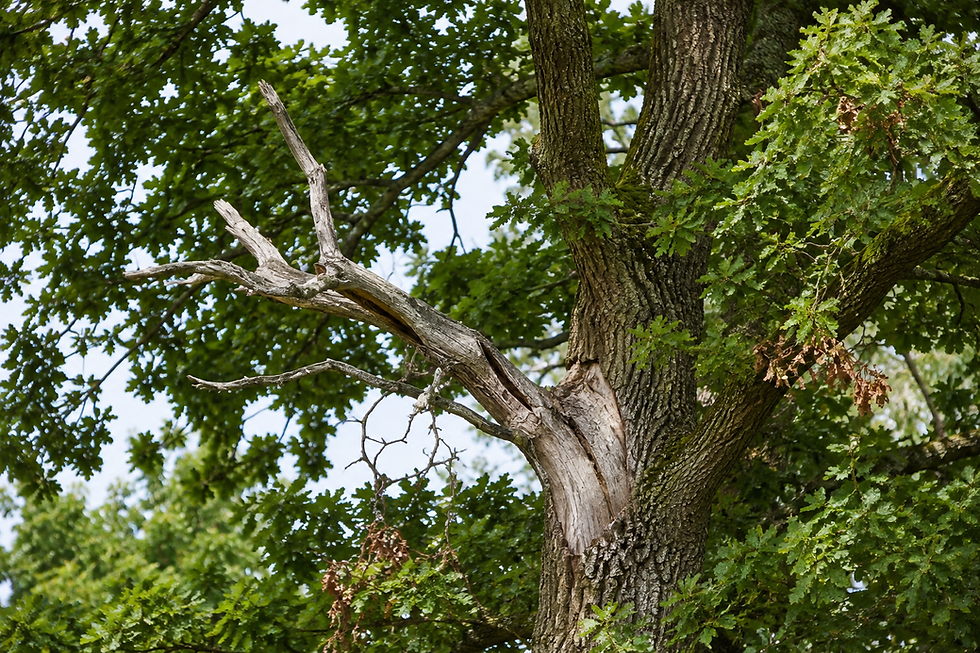
Some deadwood is completely natural. Mature and veteran trees can contain significant amounts of dead and decaying wood without necessarily being unhealthy. In fact, deadwood is an important habitat for many species, providing food, shelter and nesting opportunities for insects, fungi, birds and other wildlife.
For this reason, responsible tree management does not mean removing every dead branch.
Instead, the location, size, condition and potential risk of the deadwood should be considered alongside the ecological value of leaving it in place.
When Can Dead Branches Become a Safety Hazard?
Dead branches can become a concern when they are large, unstable or located where their failure could cause injury or damage.
Particular care should be taken with deadwood that is:
Overhanging paths, driveways or frequently used areas
Above houses, garages, sheds or other structures
Close to roads or parking areas
Large enough that it could cause significant damage if it fell
Cracked, partially detached or already hanging
Located in a part of the canopy where branch failure could affect people or property
Associated with significant structural defects or decay
Dead branches can become brittle as they dry out and may eventually break away from the tree. However, the likelihood of failure varies considerably depending on the size, position and condition of the branch, as well as the tree itself and the surrounding environment.
This is why deadwood should be assessed rather than automatically removed.
In gardens, parks and other areas where people regularly use the space beneath a tree, removing selected hazardous deadwood can be an effective way of reducing foreseeable risks.
Landowners and those responsible for trees should take reasonable steps to manage risks associated with trees where people may be exposed to them. Good planning, appropriate inspections and competent tree work can all form part of responsible tree management.
Can Deadwood Affect Tree Health?
A dead branch cannot become living wood again once it has died. However, the presence of deadwood does not automatically mean that the tree is unhealthy.
Trees naturally shed branches and sections of their canopy as they grow and age. They also have sophisticated defence mechanisms that allow them to compartmentalise areas of injury and decay.
Problems can arise when branches have broken or been damaged, leaving large wounds that may provide opportunities for decay organisms to enter the tree. Poor pruning can also increase the size of wounds and potentially create additional problems.
When deadwood does need to be removed, the work should be carried out carefully to minimise unnecessary damage to the living parts of the tree.
A skilled tree surgeon will generally avoid cutting branches flush against the trunk. Instead, the cut should respect the branch collar and the natural structure of the branch attachment.
This is important because removing a dead branch incorrectly can potentially cause more damage than leaving it in place.
Does Deadwood Removal Improve the Canopy?
Removing selected deadwood can make a tree's canopy appear less cluttered, particularly where there are numerous dead, broken or crossing branches.
It can also:
Remove damaged or unstable branches
Reduce the likelihood of dead branches rubbing against other parts of the tree
Improve visibility through the canopy
Make the tree's structure easier to inspect
Improve the overall appearance of the tree
Remove branches that could otherwise fall into areas where they pose a risk
However, deadwood removal should not be confused with crown thinning.
Crown thinning involves selectively reducing live branches throughout the canopy. Deadwood removal is much more targeted and focuses primarily on dead, damaged or potentially hazardous material.
A tree does not need to be heavily pruned to be healthy. In many situations, retaining as much of the healthy canopy as possible is preferable to unnecessary pruning.
The aim of good tree surgery is to achieve the required result while making the smallest practical intervention.
Deadwood Can Be Valuable for Wildlife
One of the most important things to understand about deadwood is that it can be extremely valuable to wildlife.
Dead and decaying wood provides habitat for a wide variety of insects, fungi and other organisms. Cavities, cracks and decaying sections of older trees can also provide nesting and roosting opportunities for birds and bats.
This is particularly important when dealing with mature, veteran or ancient trees.
Where deadwood is not creating an unacceptable safety risk, it may be appropriate to retain it. In some circumstances, fallen branches can also be left elsewhere on the property as habitat rather than being removed completely.
The Woodland Trust recommends retaining deadwood where possible because of its significant ecological value.
This means professional deadwood management is about finding the right balance between public safety, tree health and wildlife conservation.
Deadwood Removal Can Reveal Other Tree Problems
Dead branches can sometimes be an indication that something else needs attention.
During an inspection or while carrying out deadwood removal, a tree surgeon may identify signs such as:
Cavities or areas of decay
Weak or poorly formed branch unions
Cracks or splits
Fungal fruiting bodies
Storm damage
Significant areas of dieback
Signs of pests or disease
Damage around the roots or surrounding soil
Not every one of these signs means that a tree needs extensive work. Some forms of decay and deadwood are completely natural, particularly in older trees.
However, identifying potential problems allows the tree to be assessed properly and helps determine the most appropriate course of action.
Sometimes the best solution is pruning. In other cases, it may be better to monitor the tree, carry out further investigation or simply retain the deadwood because the risks are low and its wildlife value is high.
When Should Deadwood Be Removed?
There is no single time of year when all deadwood should be removed.
The appropriate approach depends on the tree species, the size and location of the deadwood, the condition of the tree, the surrounding environment and any wildlife that may be using it.
Deadwood should be considered for removal where you notice:
Large dead branches over areas regularly used by people
Hanging or partially broken branches
Branches that have recently failed
Significant amounts of deadwood following a storm
Dead branches over buildings, roads or driveways
Sudden or extensive areas of dieback
Signs of significant structural problems
Small dead twigs within the canopy are often a natural part of the tree's development and may not require any work.
Before carrying out tree work, it is also important to consider protected wildlife. Wild birds, their nests and eggs are protected by law, while bats and their roosts have particularly strong legal protection. Tree work can potentially affect bats, including through the removal of branches from mature trees.
Tree work should therefore be planned carefully, with appropriate checks made before work begins. If protected wildlife is discovered or suspected, specialist ecological advice may be required.
What About Trees With a Tree Preservation Order?
Before carrying out tree work, it is important to check whether the tree is protected by a Tree Preservation Order (TPO) or is located within a Conservation Area.
In England, consent may be required for work to a protected tree, including work on dead, dying or diseased trees, although certain exemptions can apply, including some situations involving an immediate risk of serious harm.
If you are unsure whether a tree is protected, it is worth checking with your local planning authority before arranging work.
A professional tree surgeon can also help identify whether additional permissions may need to be considered before work starts.
Why Is Professional Deadwood Removal Recommended?
Deadwood can be deceptively difficult to remove safely.
Large dead branches can be heavy and unpredictable. They may break suddenly, swing when cut or fall in an unexpected direction. Removing branches from height also presents significant risks to anyone attempting the work without the correct equipment and training.
An experienced tree surgeon will be able to assess the tree and determine which branches actually need to be removed.
They can also use appropriate climbing equipment, lowering techniques and other specialist equipment where necessary to safely dismantle branches without causing unnecessary damage to the tree or surrounding property.
Good tree work should take both tree biology and site safety into account. Cuts should be made carefully, unnecessary pruning should be avoided and the surrounding area should be properly managed while the work is carried out.
Deadwood Removal Is About Balance
Deadwood is a natural and important part of a tree's life cycle. It can provide valuable habitat for insects, fungi, birds and bats, so removing every dead branch is not always the right approach.
At the same time, dead branches can present a genuine risk when they are large, unstable or positioned above areas where people or property could be affected if they failed.
The best approach is therefore to assess each tree individually.
Where deadwood can safely remain, retaining it can benefit wildlife and contribute to the natural character of the tree. Where branches present an unacceptable risk, careful deadwood removal can help make the surrounding area safer while preserving as much of the tree as possible.
Good tree surgery isn't about removing everything that looks dead. It's about understanding the tree, assessing the risks and carrying out only the work that is genuinely needed.


Comments